
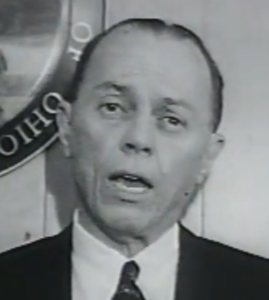
Benjamin Schwartz (c. 1904–1982) served as judge of the Hamilton County Juvenile Court in Cincinnati, Ohio, from 1957 until his retirement in 1974. Across nearly two decades on the bench, he became one of the region’s more visible figures in juvenile justice — a respected community leader who was outspoken about the challenges facing young people, and whose decisions sometimes placed him at the center of public debate.
Schwartz’s work extended well beyond the courtroom. Believing that keeping kids engaged and mentored was as important as anything that happened at a hearing, he helped found “Grid Kids,” a youth football program organized with coach Bron Bacevich and community figure Harry Goedde. The program gave generations of Cincinnati-area children a place to play, and it reflected the philosophy that guided much of his public life: that young people were worth investing in.
To a modern internet audience, Schwartz is perhaps best remembered for an unusual piece of 1964 film footage. Amid the height of Beatlemania, he appears in a short black-and-white clip warning parents about the fervor the band inspired in teenagers, cataloguing the fans’ reactions and cautioning against letting children attend such concerts. Shot by a Denver production company that was following the Beatles’ 1964 U.S. tour, the clip has taken on a second life online as a vivid snapshot of a cultural moment — and of a judge unafraid to speak his mind about the world he saw changing around young people.
His most consequential and most debated decision came in 1963, in the aftermath of the murder of fifteen-year-old Patty Rebholz in the suburb of Greenhills. Her boyfriend, Michael Wehrung, also fifteen, had become the focus of intense and repeated police questioning. Concerned that the interrogations of a minor had gone too far, Schwartz intervened, making Wehrung a ward of the state and arranging for him to attend a military school in North Carolina — a decision that effectively halted the investigation. The choice was polarizing then and remained so for decades: to the victim’s family it looked like an obstruction of justice, while others saw a judge acting to protect a child from improper pressure. When the case was reopened and brought to trial nearly forty years later, in 2001, Wehrung was acquitted — a verdict that casts Schwartz’s protective instinct in a more sympathetic and more complicated light than his critics long allowed.
Benjamin Schwartz died in 1982 at the age of 78. He left behind the mixed and human legacy of a long-serving public servant: an advocate for youth, a builder of community institutions, and a judge willing to follow his convictions even when they proved controversial.
This biography is compiled from contemporaneous and retrospective reporting by The Cincinnati Enquirer, CBS News, and Cincinnati Magazine. Some biographical details — including his birthplace, education, and family — are not well documented in publicly available sources, and additions or corrections from those who knew him are welcome.